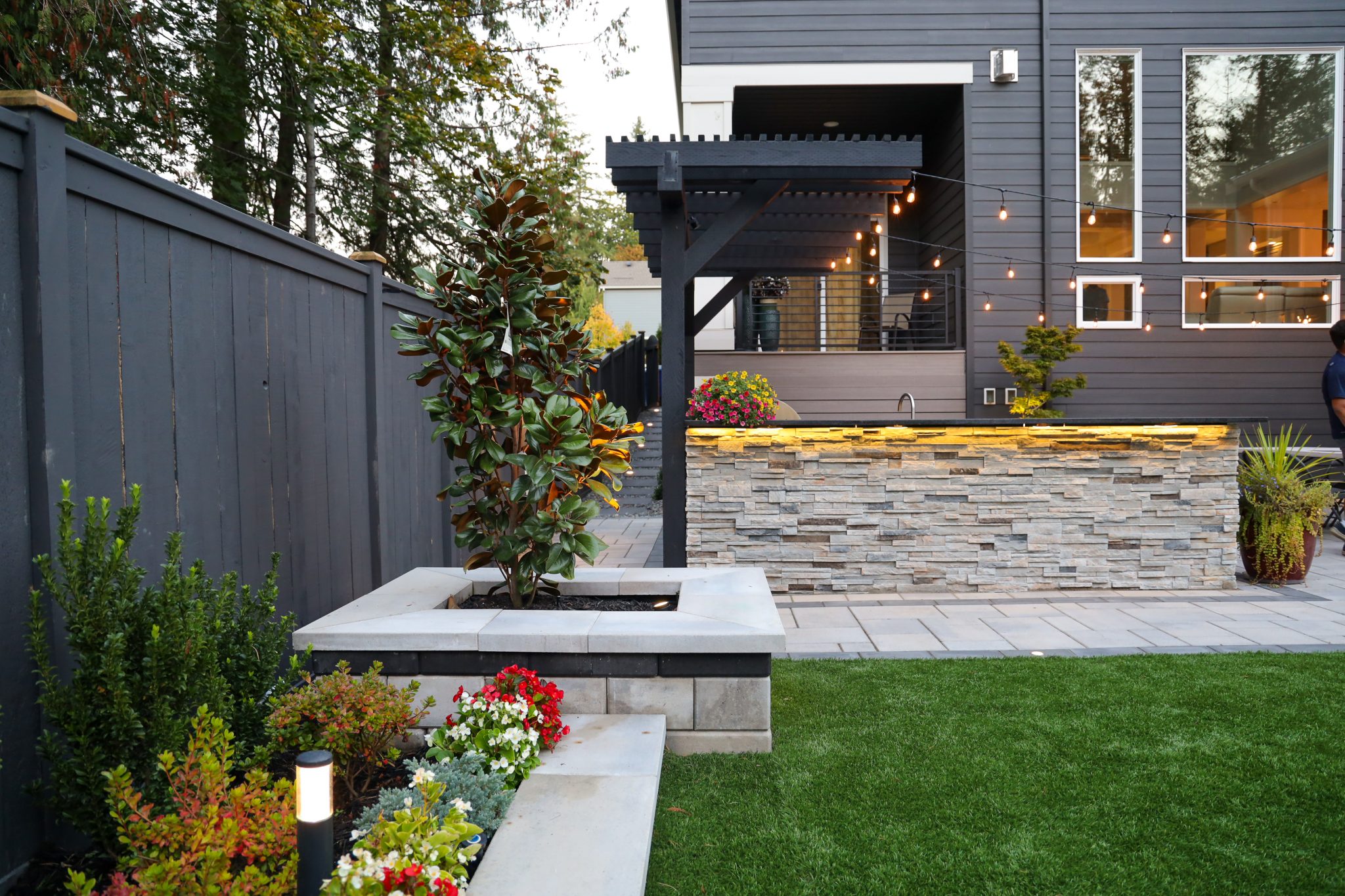
High-end landscape projects in Greater Seattle rarely stall on design. Find out where HOA landscape approval in Seattle actually slows down before you break ground.
June 26, 2026
•
10-minute read
If your property sits in a planned community from Sammamish to Mill Creek, the design you commission is not yours to build until a volunteer board signs off. That is the part most owners underestimate.
HOA landscape approval in Seattle is a private contractual review, governed by your community's covenants, conditions, and restrictions (CC&Rs). It runs completely independently from any government permit. Most boards route the request through an Architectural Review Committee, and the work usually starts with an Architectural Change Form plus a supporting design package.
For a six-figure build, that review tends to be thorough. Committees in established Eastside communities scrutinize far more than plant choices:
The packages these boards request are not casual. Expect scaled site plans, elevation drawings, material and color specs, planting schedules, and a clear drainage narrative. Many boards also require documentation showing the work will not create runoff problems for adjacent lots.
Communities around Lake Washington and the Sammamish Plateau, where lots are larger and projects more ambitious, often run the most demanding review of all.

Here is the distinction that catches even sophisticated owners off guard. Your HOA board and your county permit office answer different questions, and satisfying one does nothing to satisfy the other.
Your HOA cares whether the design fits the community's aesthetic and covenant rules. The county cares whether the build is structurally sound, drains correctly, and respects environmental regulations. On a premium project, these two reviews almost always overlap.
Sequencing is where money gets lost. Most boards want to approve the design before you finalize construction drawings, while the county will not issue a permit until those engineered drawings exist. Run them in the wrong order and you can end up paying to redraw plans more than once. A coordinated approach to HOA landscape approval in Seattle is what protects against that, because the design package and permit set get built to satisfy both audiences from the start.
The HOA approval process for landscaping usually runs on a response window the committee aims to meet, and across the industry that commonly lands at 30 to 60 days. The real timeline depends on two things: how often the committee meets and whether your packet is considered complete on arrival.
That second point is where projects quietly lose weeks. A few patterns worth planning around:
The practical takeaway for a high-end build is simple: treat approval as a lead-time item, the same way you would treat custom stone or imported fixtures. It is not a formality you handle at the end.
Not every planting refresh needs a permit. But the scope behind a high-end transformation almost always crosses a threshold that does. The first question is always jurisdiction: a property inside Seattle city limits answers to the Seattle Department of Construction and Inspections (SDCI), while unincorporated parcels answer to their county.
For context, most of the work that triggers these thresholds — retaining walls, grading, paving — falls under Angkorscape's hardscaping services, which we manage through the full approval process.
A landscape permit in Seattle and the surrounding counties typically gets triggered by:
Larger projects can also require a licensed civil engineer's stamp on grading or drainage plans once volumes climb, which is common on sloped Eastside and waterfront lots. If your project includes substantial walls, our guide on how retaining walls perform in our climate is worth a look alongside this.
For unincorporated parcels, King County landscape permits run through the Department of Local Services, Permitting Division (still widely known by its former name, DPER). This office reviews clearing and grading, building permits for structures and tall walls, and the environmental checklists that critical areas demand.
For a premium property, that usually means:
Timelines move with completeness. A clean submittal with engineered drawings clears faster than one that triggers a request for more information. The properties that move slowest are the ones where the permit set and the approved design did not match on the first pass. That mismatch is also why HOA landscape approval in Seattle and county permitting should be managed as one workflow rather than two errands.

Cross a county line and the office changes, even when the work does not. Pierce County permitting runs through Planning and Public Works on the PALS system, the county's long-running permit platform. Snohomish County uses Planning and Development Services (PDS), handling building permits, clearing and grading, and land use review for unincorporated areas through the PDS Permit Portal.
The recurring trap across all three counties is the city-versus-county line. The metro is a patchwork: a home with a Woodinville or Renton mailing address may sit in unincorporated county jurisdiction or inside an incorporated city with its own rules. Get it wrong and you submit to the wrong office, then start over.
Shoreline and critical-area overlays along Puget Sound, the river valleys, and the foothills toward the Cascades add review steps that flat inland lots never see.
Delays on premium builds are rarely about the work itself. They come from coordination breaking down between three parties who never speak to each other directly. The usual culprits:
Each of these is avoidable. The fix is having one party hold the full picture: design intent, covenant requirements, and the county's technical demands, all reconciled before anything gets submitted.
For most owners, the hardest part of a major landscape project is not choosing the design. It is the coordination: managing the architectural review committee, the county permit office, and the engineering documentation at once, while keeping all three aligned with the build schedule.
Angkorscape folds that work into a single phase. HOA packages, permits, and engineering submissions are handled by the team on the owner's behalf, including the site visits and coordination each office requires. That work sits inside a permitting phase that typically runs around three months, mapped out before anything begins so the timeline is clear from day one.
What that takes off your plate:
The payoff is that approvals stop stranding a high-end project for an entire season. Working out of the Bellevue studio, the team runs the full sequence so a build designed for spring is not still waiting on a stamp by midsummer. If you would rather have the approval process handled than handed to you, Angkorscape can walk you through exactly what your property and community will require. Schedule a consultation and someone will follow up within one business day.


If your property is in a community with an active HOA and recorded CC&Rs, yes. Most require architectural review before any significant landscape work, including hardscaping, grading, tree removal, and structures. Minor planting may be exempt, but anything that changes the look or grade of the property usually needs sign-off.
Generally the HOA approves the design first, since boards want to weigh in before construction drawings are finalized. The county permit follows once engineered plans exist. Running them out of order is the most common cause of redrawn plans and lost time.
Most committees work within a 30 to 60 day window set by their governing documents, but the real timeline depends on meeting frequency and whether your packet is complete. Some boards meet only monthly, so a single missing document can push you a full cycle. A complete, professional package is the biggest factor in getting through in one pass.
In unincorporated King County, grading of 100 cubic yards or more, creating 2,000 square feet of new impervious surface, retaining walls over 4 feet, and any work in or near a critical area typically require permits. Higher grading volumes can also trigger SEPA environmental review.
Yes. The two approvals are independent. A county permit confirms the build meets code, but your HOA can still reject a design that violates the community's covenants. This is why both reviews need coordinating from the start rather than pursued separately.
Walls over 4 feet, measured from the bottom of the footing to the top of the wall, generally require a construction permit in Seattle, and similar thresholds apply across the surrounding counties. A wall at 4 feet or under is usually exempt, though even a shorter wall can need engineering or a permit when it carries a surcharge or sits in a critical area.
The requirements are similar, but the offices and systems differ. Pierce County uses Planning and Public Works and its PALS platform; Snohomish County uses Planning and Development Services and the PDS Permit Portal. Confirming whether your parcel is city or unincorporated is the essential first step in both.
HOAs can issue fines, require you to undo or modify completed work, and place liens for noncompliance. On a high-value build, the financial and timeline risk of skipping approval far outweighs the effort of doing it properly the first time.

Serving Greater Seattle homeowners with custom outdoor living spaces. One process, one team, one result.
Contractors License : ANGKOI*750PA





.png)